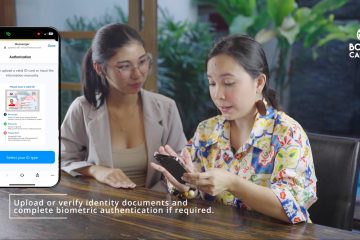
In the Philippines, over 99% of registered businesses are small enterprises—yet most are locked out of formal credit. Banks and lenders struggle with the core challenge: verifying that a business is real, solvent, and creditworthy without weeks of manual paperwork and site visits.
Boost Capital’s eKYB (electronic Know Your Business) platform solves this using VerifyIQ intelligent document processing, facial recognition, and AI-powered analysis. In minutes—not days—lenders can verify a business’s identity, its owner, its location, and its financial health. The result: faster credit decisions and lower risk.
The Business Case: Why This Matters for Lenders
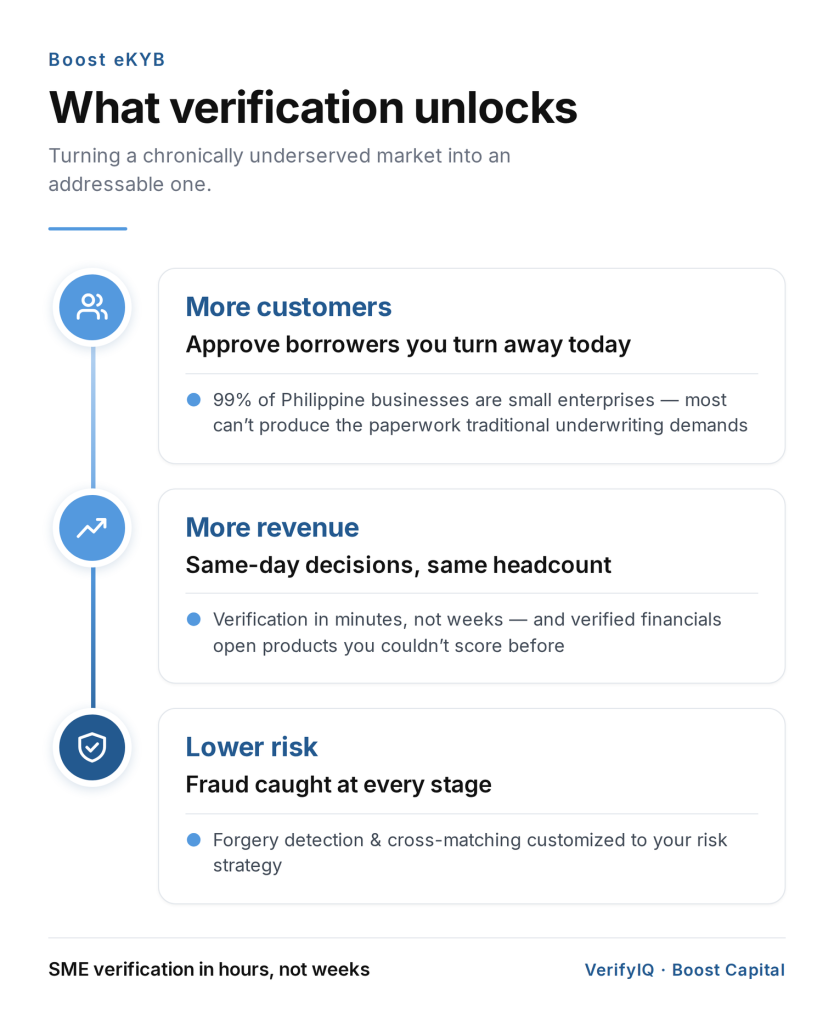
Before the mechanics, it’s worth asking: why would a bank bother? Because eKYB turns a chronically underserved market into an addressable one.
- More customers: most Philippine small business owners can’t produce the paperwork traditional underwriting demands, so they never apply—or they abandon a slow, document-heavy process partway through. A digitally-based verification flow lets lenders approve a much larger pool of legitimate borrowers, and a faster application experience means fewer prospects drop off before submitting.
- More revenue: same-day decisions mean loan officers can process far more applications without adding headcount, and approved businesses start drawing down and repaying sooner. Because the platform captures verified financial data—estimated revenue, margins, transaction history—lenders can also launch products for segments they previously couldn’t score at all, such as working capital loans, merchant cash advances, invoice factoring, or BNPL, and cross-sell once a business is verified.
- Lower risk: every stage layers in fraud detection—document forgery scoring, liveness and face-match checks, address verification, and visual cross-checks against declared inventory. That keeps fraudulent applications out of the underwriting queue, reduces bad debt on the book, and creates a consistent, auditable data trail for compliance.
Here’s how it works.
Step 1: Verify the Business Identity
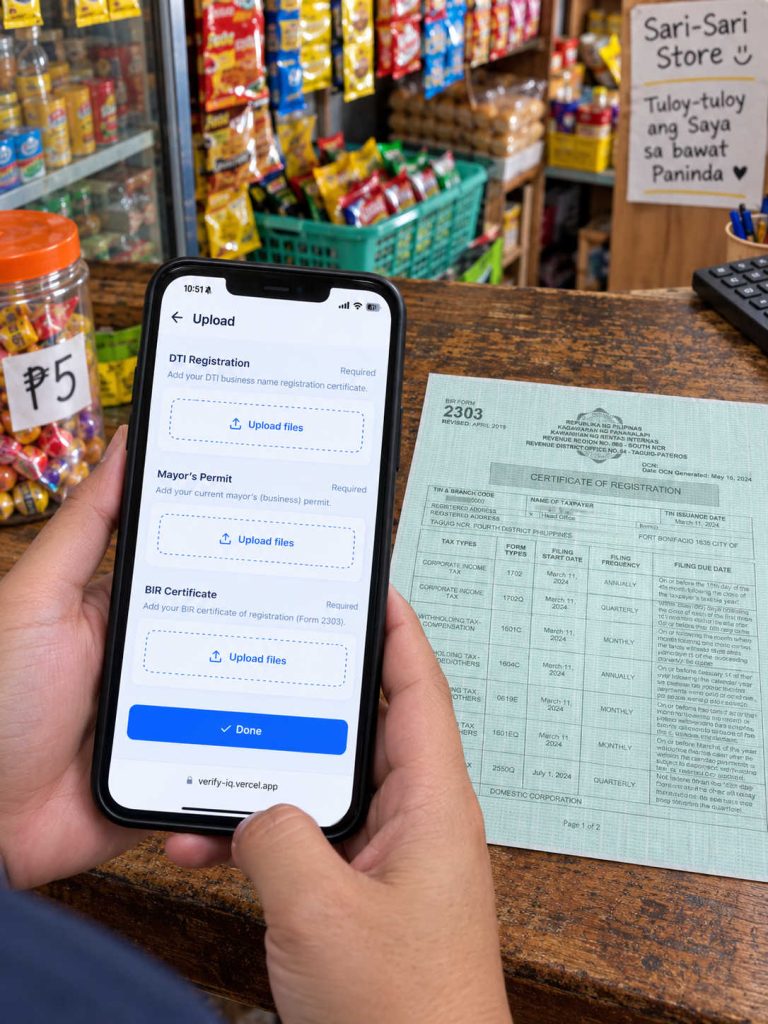
A small business begins its credit journey by uploading proof of business registration: a DTI Certificate, Mayor’s Permit, or BIR Form 2303. VerifyIQ’s OCR engine extracts key fields—business name, registration date, address, and proprietor details—with 98%+ accuracy. The system then cross-validates these fields across multiple documents to catch inconsistencies.
At the same time, our visual fraud detection model scores the document for signs of forgery, whether digital, physical, or generative. If fraud risk exceeds our threshold, the application is flagged for manual review. If it passes, we move to the next step.
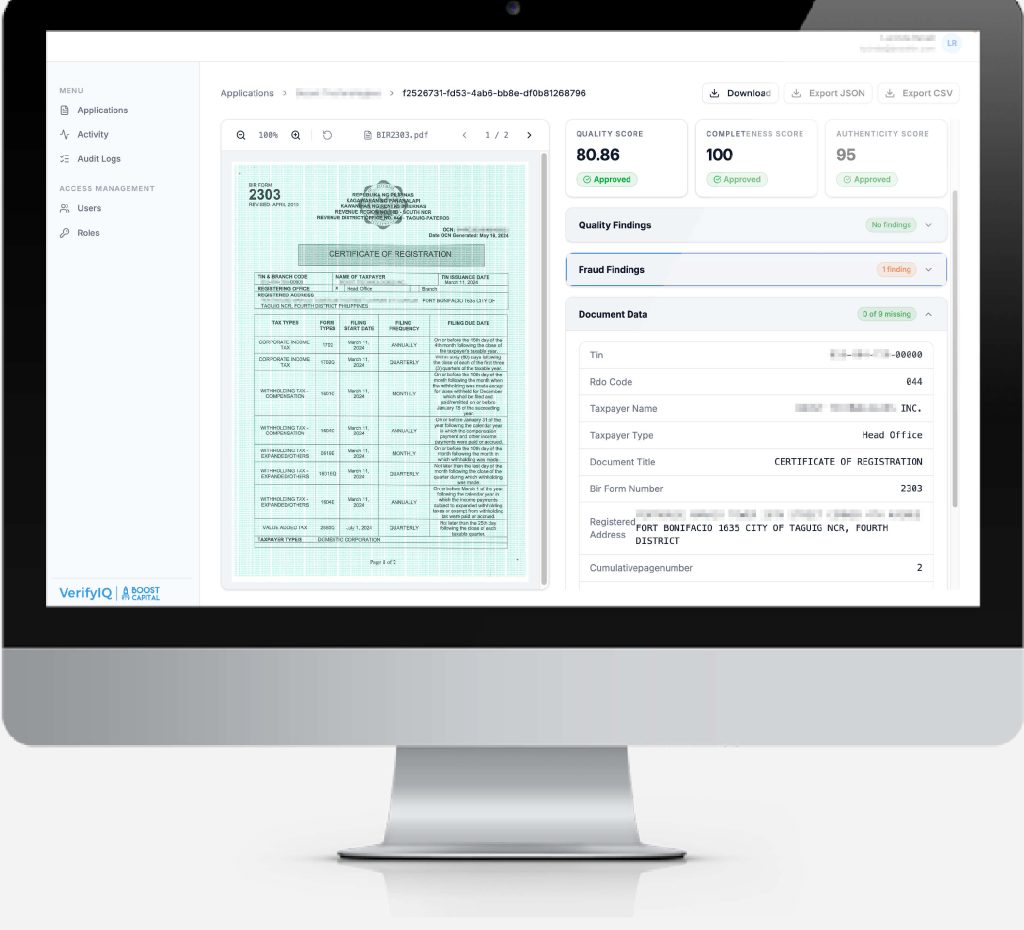
Why it matters for lenders: catching forged registration documents before they reach underwriting protects the loan book from fraud losses and saves credit officers time on applications that were never legitimate to begin with.
Step 2: Verify the Proprietor
A business is only as trustworthy as the person who runs it. Boost’s eKYC process verifies the proprietor in three steps:
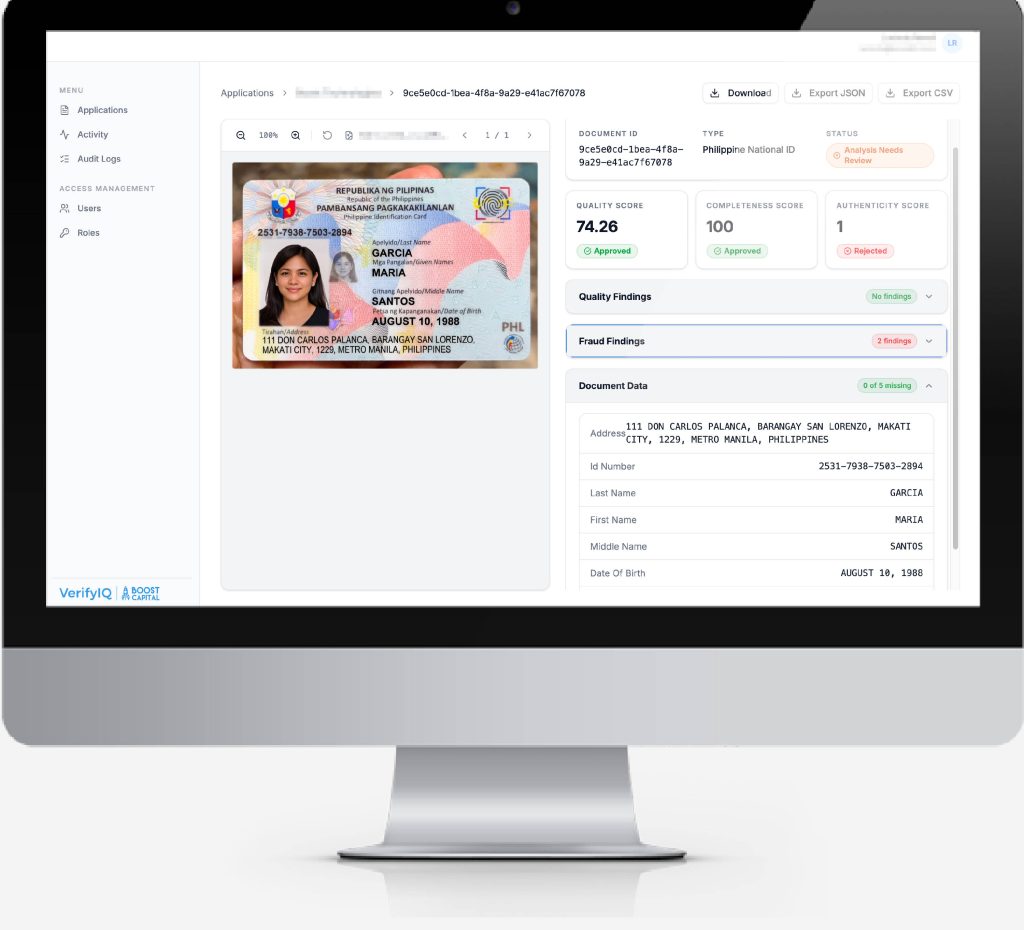
1. Identity document processing. The proprietor uploads a government-issued ID (PhilSys, Driver’s License, Passport, etc.). VerifyIQ extracts name, date of birth, ID number, and address. We cross-check this against the business registration documents from Step 1.
2. Liveness detection. To prevent identity fraud, the proprietor records a short video selfie. Our liveness detection model confirms this is a real, live person—not a photo or deepfake.
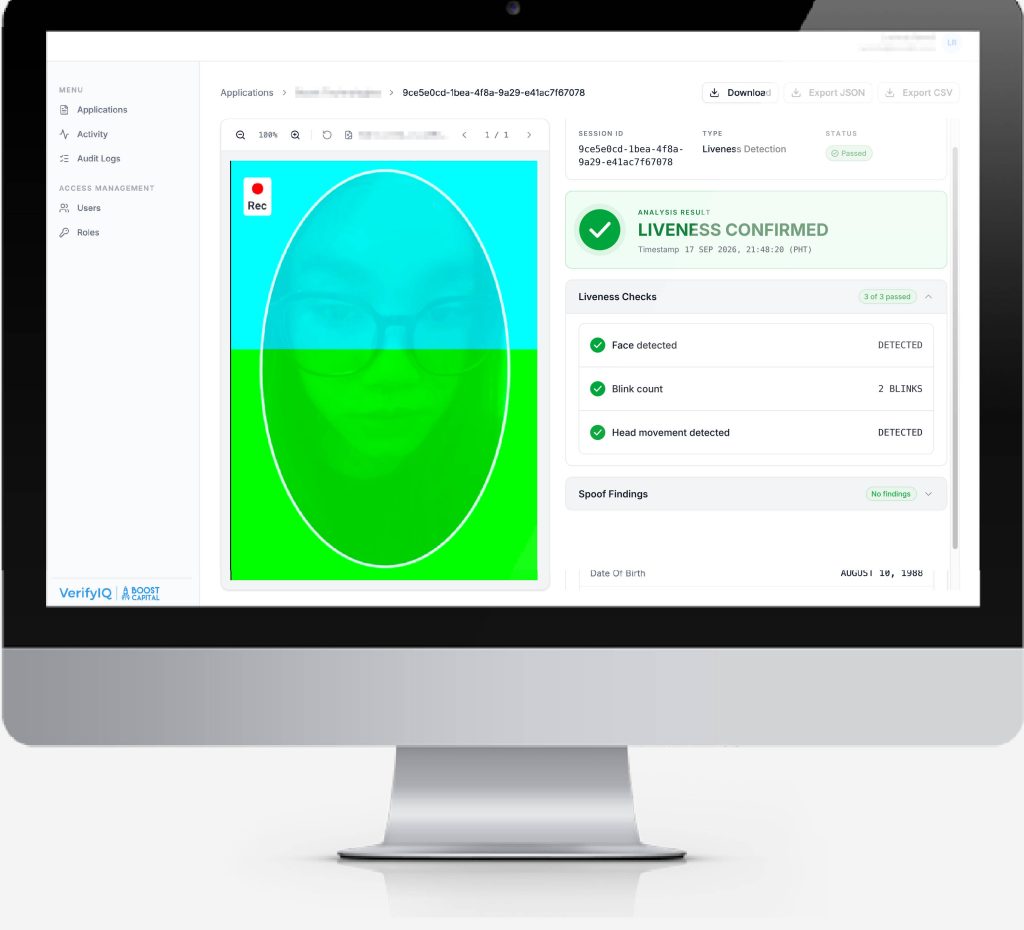
3. Facial recognition & match. The system extracts a face vector from the liveness video and compares it to the ID photograph. Our model matches faces at 89%+ confidence. If the proprietor’s face doesn’t match the ID, the application is rejected or escalated.
If all three checks pass, we confirm: this is a real person, running a real business.
Why it matters for lenders: confirming a real, live person behind the business cuts identity fraud and impersonation risk—one of the most common causes of default on unsecured small business loans—without adding friction for genuine applicants.
Step 3: Verify the Business Location
If the business has a physical location, the proprietor uploads a utility bill (electricity, water, or telco bill) showing the business address.
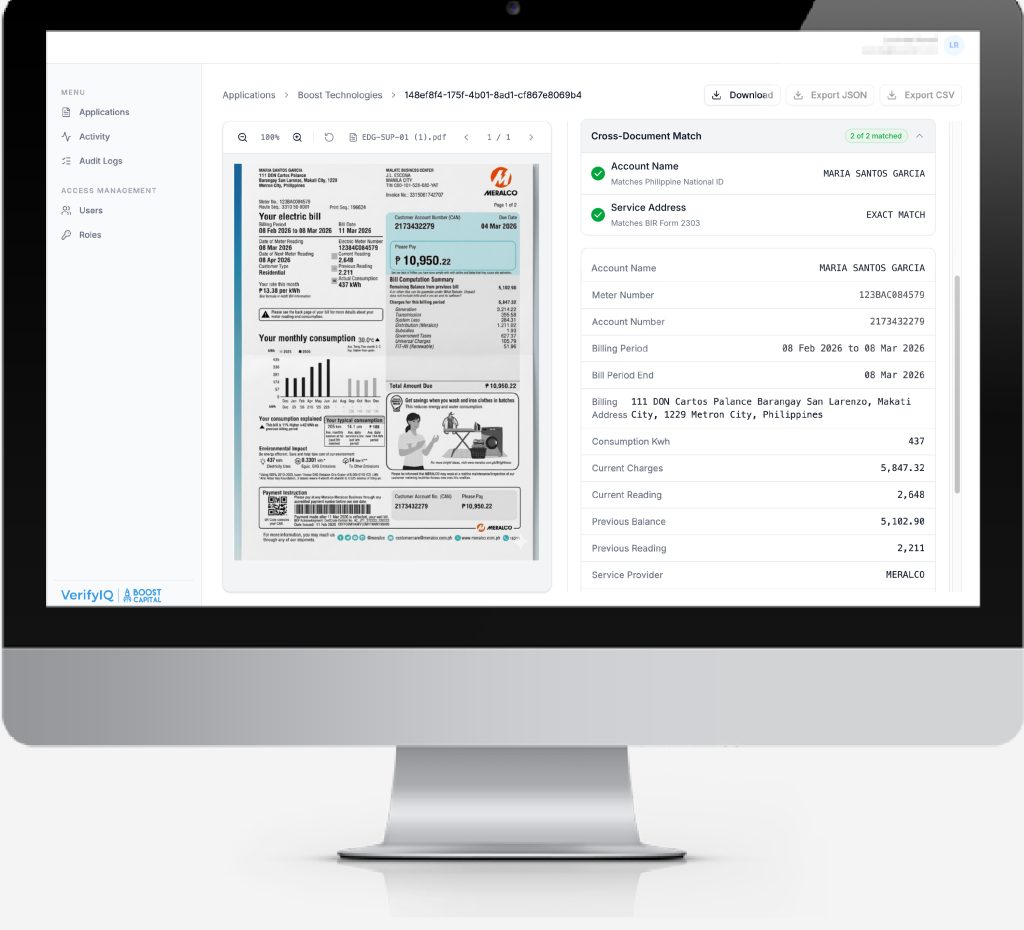
Addresses are complicated, so we need to be smart about this. Our matching algorithm handles misspellings and variation—the registered address and utility bill don’t have to be character-for-character identical, but they do have to roughly match. If the address doesn’t match, the application is flagged.
Digital businesses aren’t excluded; we just use a different verification process based on their validated P&L (see Step 4).
Why it matters for lenders: a verified address reduces collections risk and supports compliance requirements, while smart matching means legitimate businesses aren’t rejected over a typo—protecting approval rates as fraud protection improves.
Step 4: Build a P&L and Validate With Visual Proof
Here’s where Boost goes beyond simple verification into financial health assessment. The proprietor uploads business financial records:
- Invoices and receipts (sales records)
- Inventory lists or purchase orders
- Trade references (supplier or customer contact information)
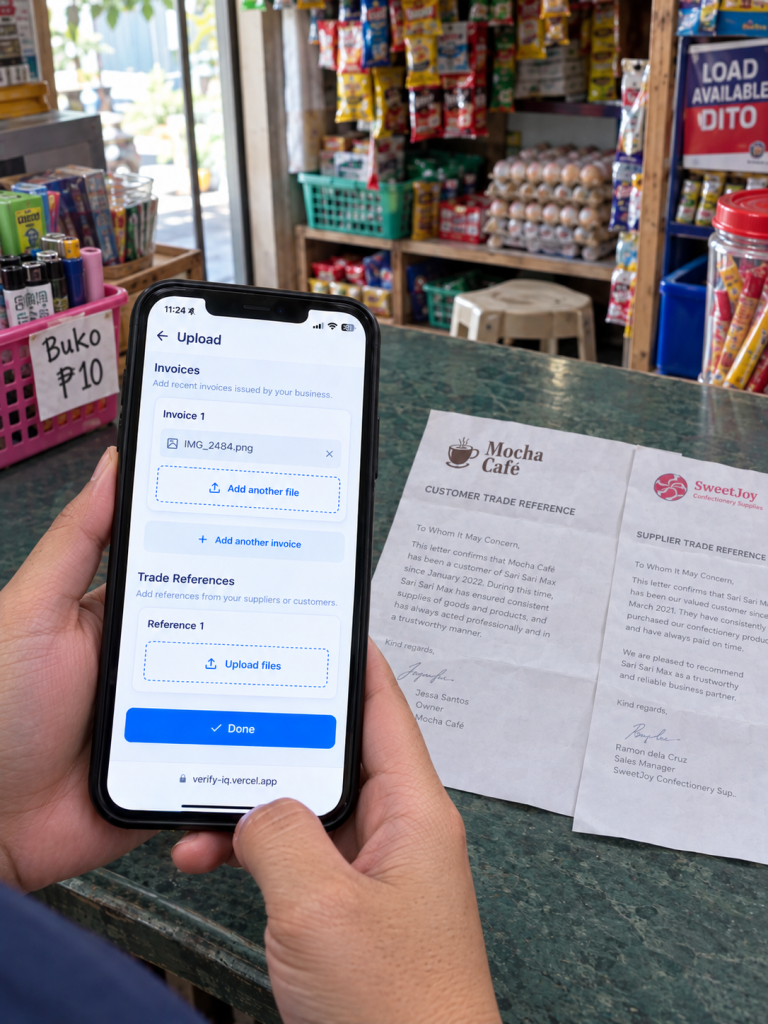
VerifyIQ’s OCR engine extracts line items, amounts, dates, and customer/supplier names from each document. The system then builds a preliminary P&L:
- Total invoiced revenue (past 3–6 months)
- Cost of goods sold (from purchase receipts)
- Expenses (utilities, staff payslips)
So we can produce estimated gross and net margins for you. If it’s not just a cash business, we can also intelligently process bank statements or e-wallet transactions as part of the P&L assessment.
But documents can be fabricated. So Boost adds visual verification:
- Inventory photos. The proprietor uploads photos of the business inventory (stock, finished goods, equipment). Our visual fraud detection model cross-checks these photos against the declared inventory list and estimated value. Example: if invoices claim 500 units of product in stock but photos show empty shelves, the application is flagged for review.
- Business tour video. The proprietor records a short video tour of the business premises. Our visual language model (VLM) annotates the video in real time: detecting equipment, signage, customer activity, inventory density, and condition. This adds a final layer of authenticity—lenders can see the business is operational, not a shell company.
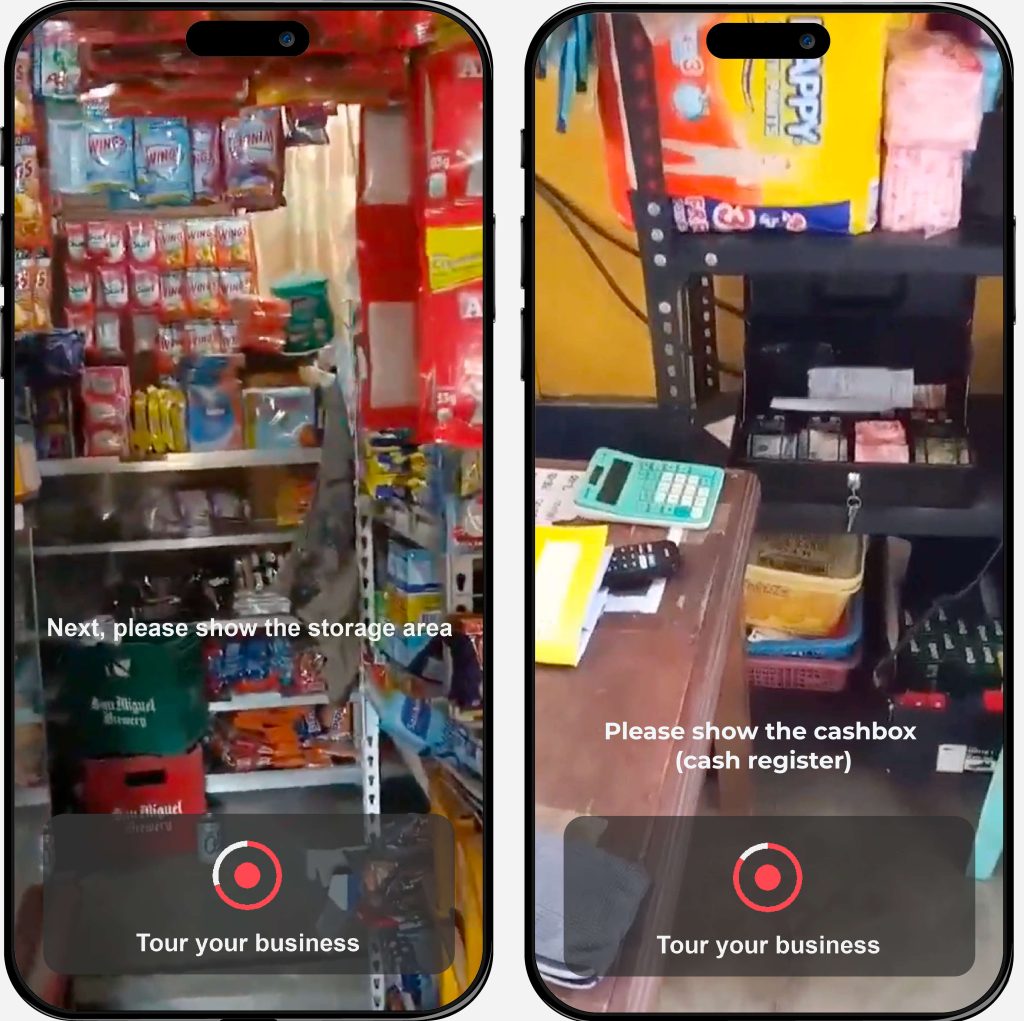
Why it matters for lenders: independent, document- and visual-derived financials let lenders extend credit to businesses with no formal accounting—opening up a large pool of new, revenue-generating customers while keeping default risk in check.
The Outcome: Credit in Hours, Not Weeks
Once all four steps are complete, the lender has:
✓ Verified business registration (DTI, Mayor’s Permit, or BIR 2303)
✓ Confirmed the proprietor’s identity (ID + face match + liveness)
✓ Validated the business address (utility bill cross-check)
✓ Assessed financial health (P&L from invoices + visual inventory proof)
✓ Detected fraud risk at every stage (visual fraud scoring on all documents)
All of this happens automatically. Lenders review the Boost eKYB report—a single dashboard showing extracted data, cross-validation results, risk flags, and confidence scores—and make a credit decision the same day.
For proprietors: no more waiting weeks for a credit analyst to manually verify documents. For lenders: lower fraud risk, faster throughput, and better data for underwriting.
For the bank, that adds up to portfolio growth: more approved applications per loan officer, a lower cost per application, and a measurably lower fraud rate—all of which improve risk-adjusted returns on the small business book, while opening a distribution channel into a segment competitors still struggle to serve profitably.
Built for Philippine Businesses
Boost’s VerifyIQ platform is trained on millions of Philippine financial documents: BDO, BPI, and GCash bank statements; DTI certificates and Mayor’s Permits; BIR forms; payslips; utility bills; and more.
We handle the real-world complexity: degraded scans, handwritten notes, multiple languages, and regional variation in document formats. Our fraud detection model recognises authentic vs. forged Philippine documents with 95%+ accuracy.
The result: eKYB that works for the Philippines—not imported templates from the US or Europe.
Ready to Unlock Credit?
Boost Capital’s eKYB platform is live with major Philippine financial institutions. If you’re a lender, fintech, or BNPL platform looking to verify small business credit in hours—not weeks—let’s talk.
For your institution, that means reaching borrowers you currently turn away, growing loan volume without growing headcount, and doing it with less fraud risk than manual underwriting ever allowed.